

How to Choose High-Quality Grain-Free Dog Food
Last Updated: November 17, 2026
Quick Summary
Choosing high-quality grain-free dog food starts with a specific reason to avoid cereal grains, confirmed with your veterinarian. Then check the label for a complete and balanced statement, a named animal protein near the top of the ingredient list, and a combined share of peas, lentils and potatoes that is not excessive.
- Grain-free is not automatically better and does not make a food hypoallergenic.
- Check that the label carries a complete and balanced statement for the right life stage.
- Add up legume and potato entries, since split ingredients can hide their total share.
- Be cautious with large-breed puppies or dogs with cardiac concerns, and ask your veterinarian first.
- Switch foods gradually over seven to ten days, mixing in more new food each day.
Table of Contents
- What Grain-Free Dog Food Means and How It Differs From Grain-Inclusive Diets
- Deciding Whether Grain-Free Food Is Right for Your Dog
- Reading the Grain-Free Dog Food Label Step by Step
- Evaluating Named Protein Sources and Meat Content
- Assessing Grain-Free Ingredients and Carbohydrate Replacements
- Switching Your Dog to a Grain-Free Diet Gradually
- Booking a Veterinary Review and Choosing Your Next Bag at Bentley's Bark
- Frequently Asked Questions
What Grain-Free Dog Food Means and How It Differs From Grain-Inclusive Diets
Grain-free dog food is a diet that excludes cereal grains such as wheat, corn, rice, and barley. It usually replaces them with other carbohydrate sources like peas, lentils, or potatoes. A grain-inclusive diet keeps those cereals in the formula, and many dogs thrive on it.
The difference matters less than the label suggests. A 2025 review of grain-free pet food composition found that essential amino acid content is generally higher in grain-free dog food than in grain-containing products. That is a nutritional observation, not a guarantee that one style is better for every dog.
Grain-free is best treated as a formulation choice, not a quality badge. The question is whether the complete food meets your dog's needs.
Deciding Whether Grain-Free Food Is Right for Your Dog
Grain-free food is not automatically the better option, and it is not automatically the wrong one. The useful question is whether there is a specific, documented reason to avoid cereal grains for your particular dog. Work through the following decision points in order, and stop at the first one that applies.
1. Does your dog have a diagnosed food allergy or intolerance? A confirmed diagnosis, ideally reached with your veterinarian, and where appropriate with an elimination diet trial, is the clearest reason to consider a limited or grain-free formula. Note that grain-free does not mean hypoallergenic. Removing cereal grains alone does not make a food hypoallergenic, because animal proteins such as chicken, beef, and dairy are more common triggers than grains. If the diagnosis points to a protein, a grain-free food built on the same protein will not help.
2. Does your dog have a medical condition that affects diet choice? Conditions such as chronic enteropathy, exocrine pancreatic insufficiency, kidney disease, or food-responsive diarrhea may call for a specific therapeutic diet. Those diets are formulated and tested for the condition, and a retail grain-free product is not a substitute. Ask your veterinarian before changing anything.
3. Is your dog a large-breed puppy or a dog with a known cardiac concern? Diet-associated dilated cardiomyopathy (DCM) has been the subject of ongoing veterinary investigation, and the concern has centered on certain grain-free formulas, particularly those heavy in legumes and potatoes, and in some cases on unusual protein sources. The evidence is not settled: researchers have not established a single causal ingredient, and most dogs eating grain-free diets do not develop DCM. A common pattern in reported cases is a diet history that includes legume-rich, grain-free formulas, often alongside other factors. For a large-breed puppy or a dog with a heart murmur or breed predisposition to DCM, raise the question with your veterinarian before choosing a grain-free product, and ask whether a grain-inclusive formula or a traditional therapeutic diet is more appropriate.
4. Is there no specific reason at all? If none of the above applies, grain-free is a preference rather than a need. Many dogs digest grains well, and grain-inclusive diets are backed by a long record of use and, in many cases, by feeding trials. Switching without a reason may add cost and complexity without a clear benefit.
5. What does your dog actually do on the food? Diet suitability is ultimately individual. A food that produces consistent stool quality, good appetite, stable weight, and healthy skin and coat in your dog is doing its job, whether or not it is grain-free. Keep a simple record for the first several weeks after any change so you can judge the response rather than the marketing.
Watch out: a dog can look healthy on a diet while a nutritional deficiency or cardiac change is developing silently, so annual veterinary checkups, including listening for a heart murmur, matter more than at-home observation alone.
A short conversation with your veterinarian, ideally with the label or product name in hand, will resolve most of these questions faster than any comparison article can.
Reading the Grain-Free Dog Food Label Step by Step
Labels hold most of the information you need. Read them in this order before comparing products.
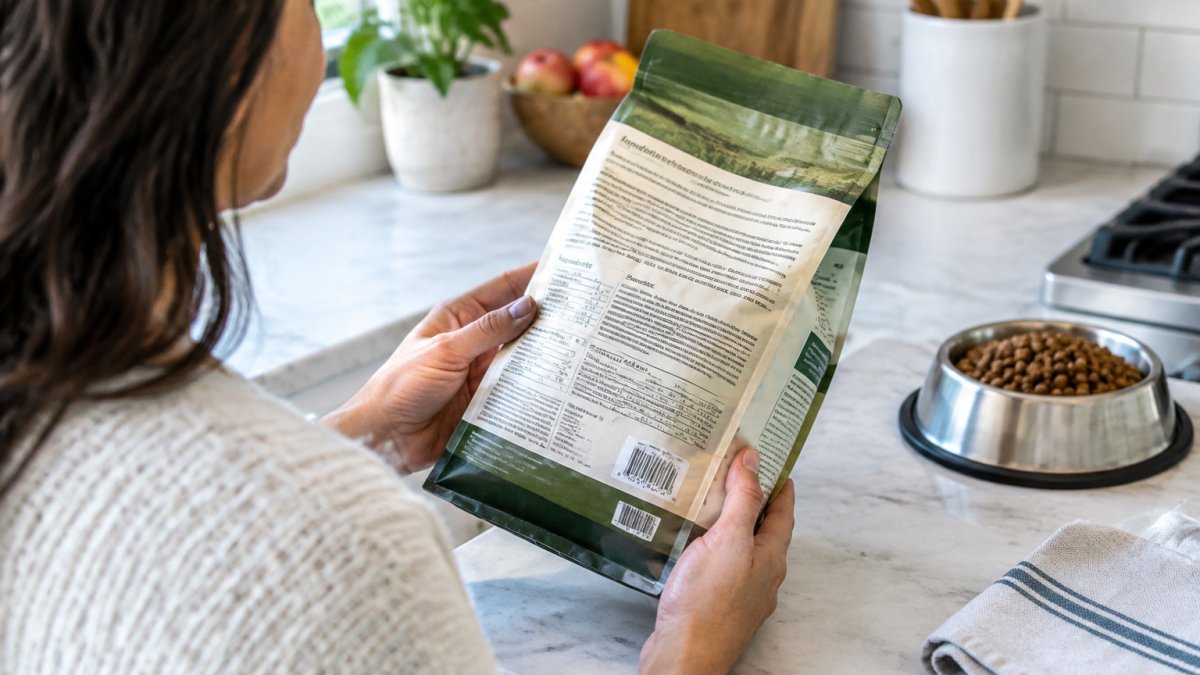
Checking the Complete and Balanced Statement
Look for a statement that the food is "complete and balanced" for a specific life stage, such as adult maintenance or growth. This wording confirms the formula meets established nutritional profiles.
Treat a statement like this as the baseline. A food that lacks it is not suitable as a primary diet, regardless of how premium the marketing looks.
Reading the Ingredient List in Order
Ingredients are listed by weight before cooking. A named meat should appear near the top. Be cautious when several carbohydrate sources sit at the front of the list.
Pay attention to where legumes and potatoes appear. A long run of plant ingredients ahead of the protein deserves a closer look.
Evaluating Named Protein Sources and Meat Content
Named proteins, such as chicken, lamb, or salmon, are more specific than vague terms like "meat by-products" or "animal protein." Specificity tells you what the dog is eating.
Check the protein percentage on the guaranteed analysis and compare it across products on a dry-matter basis. Moisture content can make a wet food look lower in protein than it is.
The article points to a few specific checks on protein content and labelling that can be compared at a glance.
| Check | What to look for | Why it matters |
|---|---|---|
| Protein sources | Named animal protein, such as chicken, lamb or salmon | Specific names tell you what the dog eats, unlike vague terms |
| Protein percentage | Compare on a dry-matter basis | Moisture can make wet food look lower in protein |
| Ingredient order | Named meat near the top of the list | Ingredients are listed by weight before cooking |
Assessing Grain-Free Ingredients and Carbohydrate Replacements
Peas, lentils, chickpeas, potatoes, sweet potatoes, and tapioca replace grains in most grain-free formulas. They are not interchangeable, and their presence alone tells you little about quality. What matters is how much of the formula they make up, how they are processed, and what else is in the bag.
What each replacement contributes. Peas and lentils are legumes: relatively high in protein for a plant ingredient, moderate in fiber, and low in glycemic impact compared with some cereals. Potatoes and sweet potatoes are starch sources, higher in carbohydrate and lower in protein than legumes. Tapioca is largely starch with little protein. A formula that leans on legumes will typically show a higher protein percentage on the guaranteed analysis than one built on potatoes or tapioca, but that protein is plant-based and has a different amino acid profile from meat.
How to read their position on the label. Ingredients are listed by weight before cooking, and split ingredients can disguise total share. A label that lists peas, pea protein, pea fiber, and lentil meal in separate slots may contain more total legume material than a label that lists a single legume ingredient higher up. Add up the legume and potato entries together before you judge the carbohydrate load. A moderate load, where a named animal protein still leads and the plant ingredients are spread through the list, is a different proposition from a formula where legumes occupy the first several slots.
The legume and DCM question, in context. Veterinary attention has focused on grain-free diets with high proportions of legumes and, in some cases, potatoes, and on the possibility that these formulas may be associated with diet-associated dilated cardiomyopathy in some dogs. The evidence remains uncertain: no single ingredient has been confirmed as the cause, and most dogs on these diets do not develop the condition. The practical response is not to avoid every food containing peas, but to weigh the overall formulation, the dog's breed and size, and the reason for choosing grain-free in the first place. For a dog with a breed predisposition to DCM, or a large-breed puppy, ask your veterinarian to review the specific formula rather than relying on the front of the bag.
Other quality signals worth checking. Look for a named animal protein in the leading positions, a guaranteed analysis that reports protein, fat, and fiber, and a complete and balanced statement for the correct life stage. Check whether the manufacturer states that the food has been through feeding trials (often described as meeting AAFCO protocols through animal feeding tests) or formulated to meet a nutrient profile, the two are not equivalent, and feeding trials provide a stronger evidence base. Note also whether the company publishes a nutritional adequacy statement and a contact route for questions; a manufacturer that answers ingredient and sourcing questions directly is usually the easier one to hold accountable.
Watch out: a grain-free formula with a long legume list and no named animal protein near the top is a poor candidate regardless of how the front of the package describes it, and a formula with a moderate carbohydrate load is not automatically better if it lacks a complete and balanced statement.
Compare two or three candidate formulas side by side using the same criteria, protein source, combined legume and potato share, adequacy statement, and feeding-trial status, before you decide.
Switching Your Dog to a Grain-Free Diet Gradually
Change foods over seven to ten days. Mix a small share of the new food into the old, and increase it each day. A dog scratcher and protector product can help keep a new routine settled while your dog adjusts.
Watch stool quality, appetite, and energy during the switch. Loose stool or reduced appetite that persists means you should pause and call your veterinarian.
Booking a Veterinary Review and Choosing Your Next Bag at Bentley's Bark
Before you commit to any grain-free food, ask your veterinarian to review your dog's diet. They can judge whether grain-free makes sense for your dog's health and history.
Once you have a plan, you can browse the Bentley's Bark selection and compare labels against the checklist above. For current pricing, check the product page or contact us directly, as pricing depends on the product and size.
Frequently Asked Questions
How do I choose a high-quality grain-free dog food?
Start by confirming the package carries a complete and balanced nutritional adequacy statement for your dog's life stage. Then check that a named animal protein, such as chicken or lamb, is listed first in the ingredient list. Compare carbohydrate sources, look for whole ingredients rather than vague by-products, and avoid relying on front-of-package claims alone. If your dog has a health condition, ask your veterinarian to review the choice before you buy.
Is grain-free dog food better for dogs?
Not automatically. Research on grain-free diets has reported differences in essential amino acid content compared with grain-containing products. Veterinarians caution against feeding grain-free food without a specific reason. Most healthy dogs digest grains well, so the decision should be individualized with veterinary guidance.
Does grain-free mean hypoallergenic?
No. Removing cereal grains does not by itself make a food hypoallergenic, because dogs can react to proteins such as beef, chicken, or dairy as well as to grains. If you suspect a food allergy, work with your veterinarian on a structured elimination trial rather than switching to a grain-free product and assuming the problem is solved.
How long should I take to switch my dog to grain-free food?
Transition over roughly seven to ten days. Start with about 25 percent new food mixed into 75 percent of the old food, then move to 50/50, then 75 percent new, and finally 100 percent new. Watch stool quality, appetite, and energy at each step. If vomiting, diarrhea, or refusal to eat persists, pause the transition and contact your veterinarian.
