

How to Keep Indoor Cats Entertained With Puzzles
Table of Contents
- Why Cat Puzzles Beat Ordinary Toys for Bored Indoor Cats
- How to Mentally Stimulate an Indoor Cat With a Daily Puzzle Routine
- Cat Puzzle Feeders: What to Put Inside and How Much
- How to Introduce a Puzzle Feeder in Five Gradual Steps
- DIY Cat Puzzle Toys You Can Build From Household Materials
- Puzzle Safety, Supervision, and Adapting Difficulty by Age and Ability
- Measuring Engagement and Keeping Puzzles Novel With Toy Rotation
- Conclusion
- Frequently Asked Questions
Last Updated: October 19, 2026
Why Cat Puzzles Beat Ordinary Toys for Bored Indoor Cats
Learning how to keep indoor cats entertained with puzzles starts with a simple fact: a puzzle feeder is a food-dispensing toy that makes a cat work for kibble or treats.
Indoor cats live in a world built for human convenience: food arrives in a bowl and the same four walls greet them every morning.
At Bentley's Bark, we think enrichment should solve a real problem, not just look cute in a photo.
Puzzles solve it because they tap into foraging, the natural sequence of sniff, stalk, bat, and reward. A wand toy gives your cat a chase.
The International Cat Care guidance on environmental enrichment makes the same point: enrichment works best when it engages several senses and gives the cat control over the outcome.
How to Mentally Stimulate an Indoor Cat With a Daily Puzzle Routine
Mental stimulation for an indoor cat works best on a schedule. Cats are creatures of habit, and a predictable routine lowers stress while still offering challenge.
Here is a daily structure that fits most households:
- Morning: one short interactive play session with a wand toy, five to ten minutes
- Breakfast: part of the kibble in a puzzle feeder instead of a bowl
- Midday: a treat hunt or a leaky ball left out for independent play
The order matters less than the rhythm. Feed, play, repeat, roughly the same time each day.
If you work long hours, the midday slot can run on its own: a treat-dispensing ball keeps a cat busy while you are away and rewards movement rather than waiting.
Cat Puzzle Feeders: What to Put Inside and How Much
What goes inside a cat puzzle feeder matters as much as the feeder itself.
Portion control is the part most people skip. A puzzle feeder is not a second meal.
A simple rule: measure the full day's food first, then split it.
Watch the size of the pieces. Tiny kibble falls out too fast and the puzzle is over in seconds.
Our Cat Treat Leaky Ball Toy is a good starting point: a treat-dispensing ball built from stainless steel and PP, lightweight at 0.21 kg, and easy for a cat to bat around on its own.
For cats that need more of a challenge, the Interactive Pet Puzzle Feeder Toy for Dogs and Cats has a detachable design that is simple to clean and refill.
How to Introduce a Puzzle Feeder in Five Gradual Steps
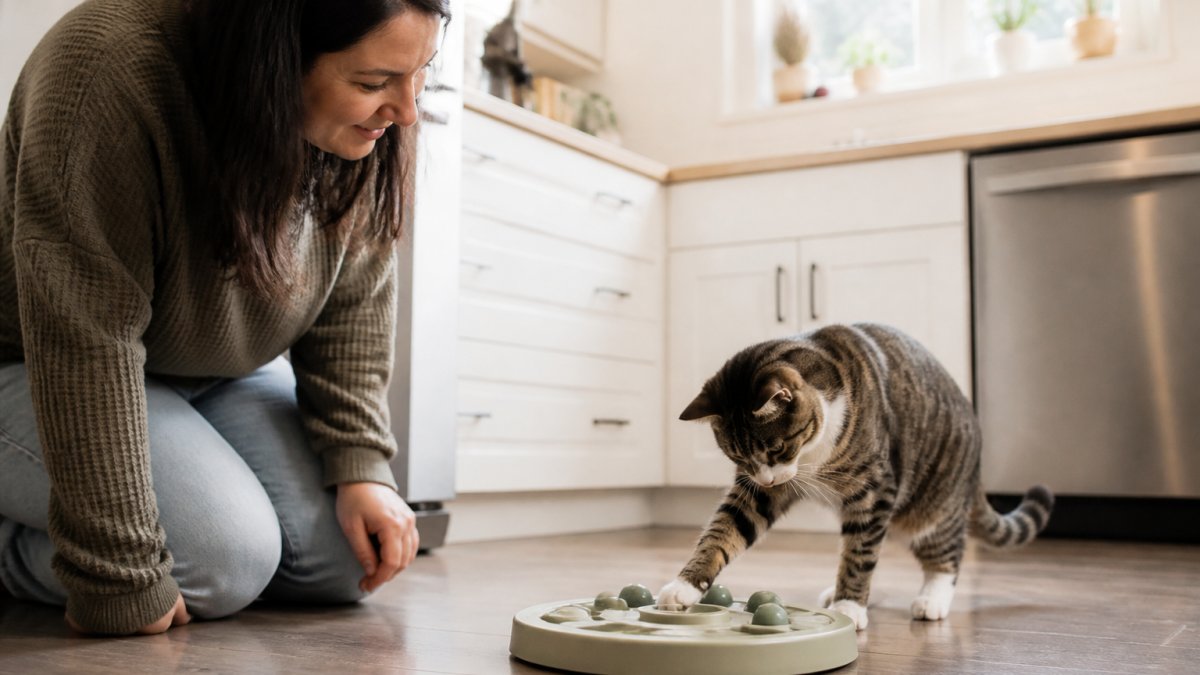
Rushing the introduction is the most common mistake we see. A cat that fails once may ignore the puzzle for weeks.
Follow these steps:
- Start with the food. Put a few treats on top of the puzzle, no assembly. Let your cat eat them off the surface. Repeat for two or three days.
- Loosen the challenge. Use the easiest setting, or leave the lid off. The goal is success, not struggle.
- Add one small step. Partly cover the treats so your cat has to nudge them loose. Watch for paws, not panic.
- Go to full difficulty. Once your cat solves the loose version quickly, close it up. Expect a few frustrated meows. That is normal.
- Rotate it in. Use the puzzle for one meal a day, not every meal, so it stays interesting.
Expected result: most cats solve a simple puzzle within a few sessions. If yours walks away, go back a step and stay there longer.
DIY Cat Puzzle Toys You Can Build From Household Materials
DIY cat puzzle toys cost almost nothing, take minutes to build, and are a smart way to test whether your cat likes puzzles before you buy anything. What separates a DIY toy that works from one that ends up under the couch is specificity: exact materials, exact assembly, and a clear difficulty rating.
Here are three builds that hold up to daily use, rated by difficulty.
Build 1: The Muffin-Tin Forager (Easy)
Materials: one standard 12-cup muffin tin, 12 ping-pong balls or crumpled squares of paper, a handful of kibble or small treats.
Assembly:
- Drop two or three pieces of kibble into each muffin cup.
- Place one ping-pong ball over each cup so it sits loosely in the depression.
- Set the tin on the floor and let your cat investigate.
How it works: Your cat has to lift, bat, or nudge the balls aside to reach the food.
Safety notes: Ping-pong balls are large enough that most cats cannot swallow them, but check they cannot wedge in your cat's mouth.
Difficulty adjustment: Start with the balls half off the cups so food is partly visible.
Build 2: The Folded-Roll Treat Drop (Easy to Moderate)
Materials: one empty toilet paper roll or paper towel roll cut in half, a few pieces of kibble, scissors.
Assembly:
- Fold one end of the roll closed and press the crease firmly.
- Drop three or four pieces of kibble into the open end.
- Fold the open end loosely closed, leaving a small gap.
- Hand it to your cat or set it on the floor.
How it works: Your cat bats the roll around until the loose end opens and food falls out.
Safety notes: Discard the roll once the food is gone; chewed, damp cardboard can break into small pieces and cause a blockage.
Difficulty adjustment: Fold the open end more tightly for a harder puzzle, or leave it barely closed for a cat that is new to foraging.
Build 3: The Box Maze (Moderate)
Materials: one shallow cardboard box (a shoe box or shipping box works), a utility knife or scissors, a marker, treats.
Assembly:
- Draw three or four circles about the width of your cat's paw on the sides and lid of the box.
- Cut the holes out. Smooth any rough edges with the back of the knife or a piece of tape folded over the edge.
- Drop treats inside the box and close the lid.
- Set the box on the floor and let your cat reach in from different angles.
How it works: Your cat has to reach through the holes and fish the treats out, a different motor skill than batting a ball.
Safety notes: Tape down every cut edge so your cat cannot catch a claw or lip.
Difficulty adjustment: Start with the lid off so your cat can see the treats.
Rules That Keep Every DIY Build Safe
A few rules apply to all three builds: tape down sharp edges, skip anything small enough to swallow, and remove string, rubber bands, and tape when done. Never leave a DIY toy with loose string, ribbon, or small parts unattended; cats swallow linear objects, and that can mean surgery. Supervise, then put it away.
Store-bought puzzles still have a place. They tend to be sturdier, easier to clean, and harder to solve, which matters once your cat has mastered the homemade versions. Use the DIY builds to learn what your cat likes, then invest in a durable puzzle that matches that preference.
Puzzle Safety, Supervision, and Adapting Difficulty by Age and Ability
Puzzle safety comes down to three things: supervision, size, and fit. Supervise new puzzles until you know your cat uses them safely, check that no part is small enough to swallow, and match the puzzle to your cat's body, not just its age.
The Supervision Protocol
Treat a new puzzle like a new toy until proven safe:
- First session: sit on the floor with your cat. Watch the mouth, not just the paws. A cat that starts chewing the puzzle rather than working it is telling you the puzzle is too hard or the food is too accessible.
- Second and third sessions: stay in the room but move a step away. Watch for pieces coming loose, edges being gnawed, or the cat trying to carry the puzzle off.
- After three clean sessions: the puzzle can be left down for short unsupervised periods, but only if it has no detachable parts smaller than your cat's mouth and no strings, ribbons, or elastic.
Retire any puzzle that develops a crack, a loose cap, or a chewed edge; bitten plastic can splinter, and a swallowed fragment is a veterinary emergency.
Material and Cleaning Checks
Before first use, run a finger along every edge and inside every channel; anything that catches a fingernail can catch a tongue or paw pad.
Clean puzzle feeders after every few uses, or more often if the food is wet. Warm water and mild dish soap are enough for most designs; rinse thoroughly and dry completely before refilling, because damp kibble grows mold quickly.
Adapting Difficulty by Age and Ability
Adapting difficulty is where most guides stop short. A kitten and a senior cat need very different setups, and the adjustment is usually mechanical rather than a different product.
- Kittens: easy puzzles, short sessions, lots of success. Their attention span is short, and their coordination is still developing. Use wide channels and large pieces. End the session while the kitten is still interested rather than waiting for it to walk away.
- Adult cats: full difficulty, rotated often, with new layouts to keep it fresh. Adults are the easiest group to challenge; the main risk is that a puzzle becomes too familiar rather than too hard.
- Seniors: wide channels, shallow puzzles, and soft food if teeth are sensitive. Raise the puzzle slightly if reaching down is hard. A senior cat with reduced vision benefits from puzzles where the food is visible at the start.
The American Association of Feline Practitioners' environmental needs guidelines recommend matching enrichment to the individual cat rather than a one-size plan, which is exactly the point here. The practical version of that advice is to change one variable at a time: channel width, food visibility, or puzzle height, never all three at once.
Measuring Engagement and Keeping Puzzles Novel With Toy Rotation
Engagement tells you whether the puzzle is working. Watch for these signs:
- Your cat approaches the puzzle without being prompted
- Paws and nose go to work within a minute
- Your cat returns to it after walking away
If your cat ignores the puzzle, it is usually too hard, too easy, or too familiar. Adjust one thing at a time.
Toy rotation solves the familiarity problem. Cats lose interest in toys that never change. Keep a small collection and swap it every few days.
| Problem | Likely Cause | Fix |
|---|---|---|
| Cat ignores the puzzle | Too hard or too new | Go back a step, add treats on top |
| Cat solves it in seconds | Too easy | Tighten the setting or switch puzzle type |
| Cat loses interest after a week | No novelty | Rotate toys, change the filling |
| Cat eats too fast still | Portion too small | Split the daily ration across two puzzles |
| Cat gets frustrated | Pieces too big or jammed | Check treat size against the channel |
For cats that need movement as well as thinking, the Smart Auto-Rolling Pet Ball adds a physical chase to the routine.
Conclusion
Knowing how to keep indoor cats entertained with puzzles is not about buying more toys.
Start with one puzzle, introduce it slowly, and adjust as your cat learns. Then rotate it with play sessions, a treat hunt, and something to climb or watch.
Bentley's Bark carries hand-picked enrichment tools for exactly this. Our puzzle feeders and treat-dispensing toys are chosen to solve real problems, and every order ships free.
Frequently Asked Questions
How long should a cat play with a puzzle toy?
Most cats stay engaged with a puzzle for 10 to 20 minutes before losing interest, though a food puzzle may hold attention longer if it still has treats inside. Short, frequent sessions work better than one long one. Try two or three puzzle sessions a day, and put the toy away once your cat walks off. That keeps the puzzle feeling new and prevents frustration from building up.
How do you know if a puzzle is too difficult for your cat?
Watch the first two minutes. If your cat sniffs the puzzle, walks away, or paws at it without any treat coming loose, it is too hard. Start with a puzzle where treats sit openly on top, then move to covered compartments. A cat puzzle should be solvable within a few minutes at first. If your cat gives up repeatedly, go back one difficulty level and rebuild confidence.
Can you make a safe puzzle toy for a cat at home?
Yes. A muffin tin with treats in the cups and tennis balls on top is a classic DIY cat puzzle, and a cardboard box with holes cut in the sides works well for hiding kibble. Skip anything with string, small caps, or glued parts that could come loose. Check homemade toys for sharp edges before each use, and supervise the first few sessions.
What should you put in a cat puzzle feeder?
Use your cat's regular kibble, freeze-dried treats, or small pieces of cooked chicken. Keep the total amount small and subtract it from the day's meals so you do not overfeed. Strong-smelling treats work best for the first few sessions because they motivate your cat to keep trying. Avoid sticky or crumbly foods that are hard to clean out of the puzzle.