

How to Choose an Air Purifier for Multiple Pets
Table of Contents
- Start With Pet Load, Not Just Room Size
- Air Purifier Room Size and CADR: The Numbers That Matter
- Air Purifier for Pet Dander: Why True HEPA Filtration Is Non-Negotiable
- Air Purifier for Pet Odor: What Activated Carbon Actually Does
- One Unit or Several? Whole-Home Strategy for Multi-Room Households
- Air Purifier Filter Replacement Frequency in a Pet Home
- Safe Operation Around Pets and Features Worth Paying For
- Conclusion
- Frequently Asked Questions
Last Updated: October 12, 2026
Start With Pet Load, Not Just Room Size
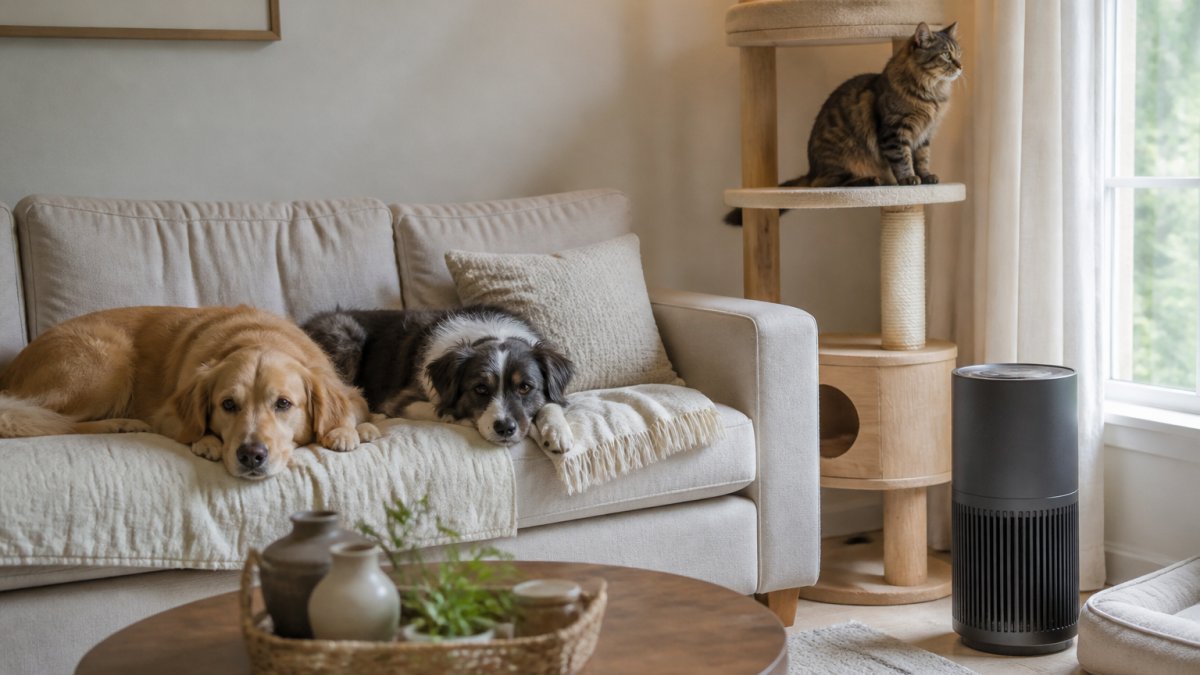
Most guides tell you to match an air purifier for pets to your square footage. That advice fails in a home with multiple pets. Two cats and a shedding dog produce far more dander, hair, and odor than the same room occupied by one goldfish, yet the room is the same size. If you want to know how to choose an air purifier for multiple pets, start by counting noses, not just measuring walls. The fix is a sizing method that accounts for pet load first.
A Practical Sizing Method for Multi-Pet Homes
Here is a simple way to estimate the purifier capacity you actually need.
- Count each dog as 1 unit, each cat as 0.5 units
- Add 1 extra unit if any pet sheds heavily
- Match total units to a coverage area, not just room size
A single large dog in a 30 square metre room may need the same purifier as three cats in the same space. When in doubt, size up. A larger unit running on low is quieter and cheaper to run than a small unit straining on high.
Air Purifier Room Size and CADR: The Numbers That Matter
CADR, or clean air delivery rate, tells you how much filtered air a unit moves per minute. It is the single most useful spec for comparing purifiers, and it is the number most pet owners skip. Room size alone tells you nothing about how fast a unit clears the air. A high CADR means more air changes per hour, which matters more in a pet household where dander stays airborne.
How to Turn CADR Into a Real Coverage Number
A common rule of thumb is that a purifier's suggested room size assumes about four air changes per hour (ACH) at a 2.4-metre ceiling. To check whether a unit is actually sized for your space, use this method:
- Measure the room's floor area in square metres.
- Multiply by the ceiling height in metres to get cubic metres of air volume.
- Multiply the unit's CADR (in cubic metres per hour) by 60 to get cubic metres of clean air per hour.
- Divide that clean-air figure by the room's air volume. The result is your air changes per hour.
A bedroom of 15 square metres with a 2.4-metre ceiling holds about 36 cubic metres of air. A unit rated at 200 cubic metres per hour of CADR delivers roughly 5.5 air changes per hour in that room, comfortably above the four-ACH baseline. The same unit in a 40-square-metre open-plan space drops to about 2 ACH, which is where pet dander starts to outpace filtration.
Adjusting CADR for Pet Load
Square footage assumes a room with no pets. In a multi-pet home, treat the pet load as an extra multiplier on the air volume you need to clean:
- One dog or two cats: add roughly 25% to the target CADR.
- Two dogs or three or more cats: add roughly 50%.
- Heavy shedders, double coats, or a home with both dogs and cats: add 75% or more.
A 30-square-metre living room with two shedding dogs is not a 30-square-metre job. It is closer to a 45- to 50-square-metre job, and the CADR should reflect that. When in doubt, size up. A larger unit running on low is quieter and cheaper to run than a small unit straining on high.
| Room Type |
|---|
| --- |
| Bedroom |
| Open-plan living area |
| Multi-pet room |
| Why It Matters With Pets |
|---|
| --- |
| Larger air volume, more dander to clear |
| Heavy shedding raises particle load |
The Association of Home Appliance Manufacturers explains how CADR testing standards work, and it is worth reading before you buy. Note that CADR is measured on the highest fan speed with a clean filter.
Air Purifier for Pet Dander: Why True HEPA Filtration Is Non-Negotiable
True HEPA filtration captures the tiny particles that trigger allergies. Pet dander particles are small enough to stay airborne for hours, so a filter that only catches hair will miss the real problem. A True HEPA filter traps these fine particles, while a carbon layer handles odor. This is the core of any air purifier for pet dander. Skip the marketing claims and check the filter spec sheet directly.
Pet Hair vs. Airborne Dander: Two Different Problems
Pet hair is visible and lands on surfaces. Airborne dander floats and gets inhaled. A pre-filter handles the hair. A True HEPA filter handles the dander. You need both, and a purifier alone won't fix shedding at the source.
That is where grooming comes in. The ASPCA's pet care guidance notes regular grooming reduces loose fur. We recommend the Davis De-Shed Pet Rinse to loosen undercoat before brushing, paired with our Wooden Handle Needle Brush for daily removal.
Air Purifier for Pet Odor: What Activated Carbon Actually Does
Activated carbon absorbs odor molecules rather than masking them. The amount of carbon in the filter matters more than the label. Thin carbon sheets fade fast in a multi-pet home. A thick carbon filter lasts longer and handles stronger odors. This is the key difference in any air purifier for pet odor. Look at the carbon quantity, not just the word "carbon" on the box.
Setting Realistic Odor Expectations
No purifier eliminates pet odor completely. It reduces it, especially between cleanings. Pair the purifier with regular washing of bedding and a surface neutralizer. We like the Loona Allergens Neutralizer, which captures allergens in the air so they can be vacuumed away.
Loona - Allergens Neutralizer - 500 ml →
One Unit or Several? Whole-Home Strategy for Multi-Room Households
One large purifier rarely covers a whole home well. Air does not flow freely between closed rooms, so a single unit in the hallway leaves bedrooms untreated. A better approach is one unit per high-use room, or a large unit in the main living space plus smaller units in bedrooms. This whole-home strategy keeps dander down everywhere your pets spend time.
- Main living area: one high-CADR unit
- Each bedroom: a smaller, quiet unit
- Pet sleeping spots: closest to the source
For multi-room homes, running several units on low often beats one unit on high. It is quieter and spreads coverage more evenly.
Air Purifier Filter Replacement Frequency in a Pet Home
Pet homes clog filters faster than pet-free homes. Hair and dander fill the pre-filter quickly, and the HEPA layer loads up sooner. Check the pre-filter every few weeks and rinse it if it is washable. Replace the HEPA and carbon filters on the schedule the maker recommends, or sooner if airflow drops. A clogged filter wastes energy and stops cleaning the air. Air purifier filter replacement frequency is not a set number. It depends on how many pets you have and how much they shed.
What Replacement Actually Costs Over Time
This is the part most buying guides skip, and it is the part that decides whether a purifier is worth owning. The purchase price is a one-time cost. Filters are a subscription you did not sign up for.
In a pet-free home, that filter might last 12 months. In a multi-pet home, expect 6 to 9 months, and in a heavy-shedding household with several animals, 4 to 6 months is realistic.
Electricity is the other ongoing cost. A unit drawing 40 to 60 watts on a medium setting, running 24 hours a day, uses roughly 350 to 525 kilowatt-hours per year. At typical residential rates, that is a meaningful line item if you are running several units. Check the wattage on the spec sheet, not just the noise rating.
A Maintenance Schedule That Works With Pets
- Weekly: vacuum or rinse the pre-filter. In a heavy-shedding home, twice a week is not excessive.
- Monthly: inspect the HEPA and carbon layers for visible loading and check for airflow drop.
- Every 4 to 9 months: replace the HEPA and carbon filters, sooner if you notice odor returning or the fan sounding strained.
- Annually: review whether your replacement interval still matches your pet load. Adding a pet changes the math.
One more thing worth knowing: carbon filters lose odor-absorbing capacity even when they still look clean, because the carbon is saturated rather than clogged. If pet odor returns before the HEPA layer looks dirty, the carbon is the part that needs replacing.
Safe Operation Around Pets and Features Worth Paying For
Most purifiers are safe around pets, but placement and features matter. Keep cords out of reach and place units where a curious cat cannot tip them. Choose a unit with a locked control panel if your pet is clever. Features worth paying for include:
- True HEPA plus a thick carbon filter
- A washable pre-filter for hair
- Quiet fan speeds for bedrooms
- A pet-lock or child-lock control
Skip fancy extras that do not affect air quality. Focus your budget on filtration, airflow, and a low noise level. Energy consumption also adds up, so check the wattage if you plan to run units all day.
Conclusion
Choosing an air purifier for pets in a multi-pet home comes down to pet load, real filtration, and coverage. Get the sizing right, insist on True HEPA and real carbon, and plan for frequent filter checks. Bentley's Bark helps you handle the source of the problem too, with grooming tools like the Davis De-Shed Pet Rinse and our Wooden Handle Needle Brush, plus the Loona Allergens Neutralizer for surfaces. Every order ships free, and our curated selection is chosen to solve real pet-parent problems. Get started with Bentley's Bark and build a cleaner, fresher home for you and your pets.
Frequently Asked Questions
What size air purifier do I need for a home with multiple pets?
Start with the room's square footage, then add a buffer for each additional pet. A purifier rated for 30 square metres works for one cat in a bedroom, but two dogs in the same space need a unit rated well above the room's actual size. Check the CADR on the box and aim for a clean air delivery rate that turns the room's air over at least four times per hour.
Are HEPA air purifiers effective for pet dander?
Yes. A True HEPA filter captures 99.97 percent of particles at 0.3 microns, which includes the dander and allergen particles pets shed. Pair it with regular grooming and vacuuming, since the filter only cleans air that reaches it. A rinse like Davis De-Shed Pet Rinse loosens undercoat before brushing, so less dander and hair circulate in the first place.
Can an air purifier remove pet odors?
An air purifier with a thick activated carbon filter reduces pet odors, but it will not eliminate them entirely. Carbon absorbs odor molecules as air passes through, so a thin carbon pad saturates fast in a multi-pet home. Look for a unit with a substantial carbon layer, and treat the purifier as one part of odor control alongside washing bedding and cleaning surfaces.
How often should I replace an air purifier filter in a home with pets?
In a multi-pet home, expect to replace the HEPA filter every six to twelve months instead of the standard twelve. Check it monthly: hold it up to light, and if you cannot see through it, replace it. Pre-filters need rinsing or vacuuming every two to four weeks, since they catch the bulk of pet hair before it reaches the HEPA layer.